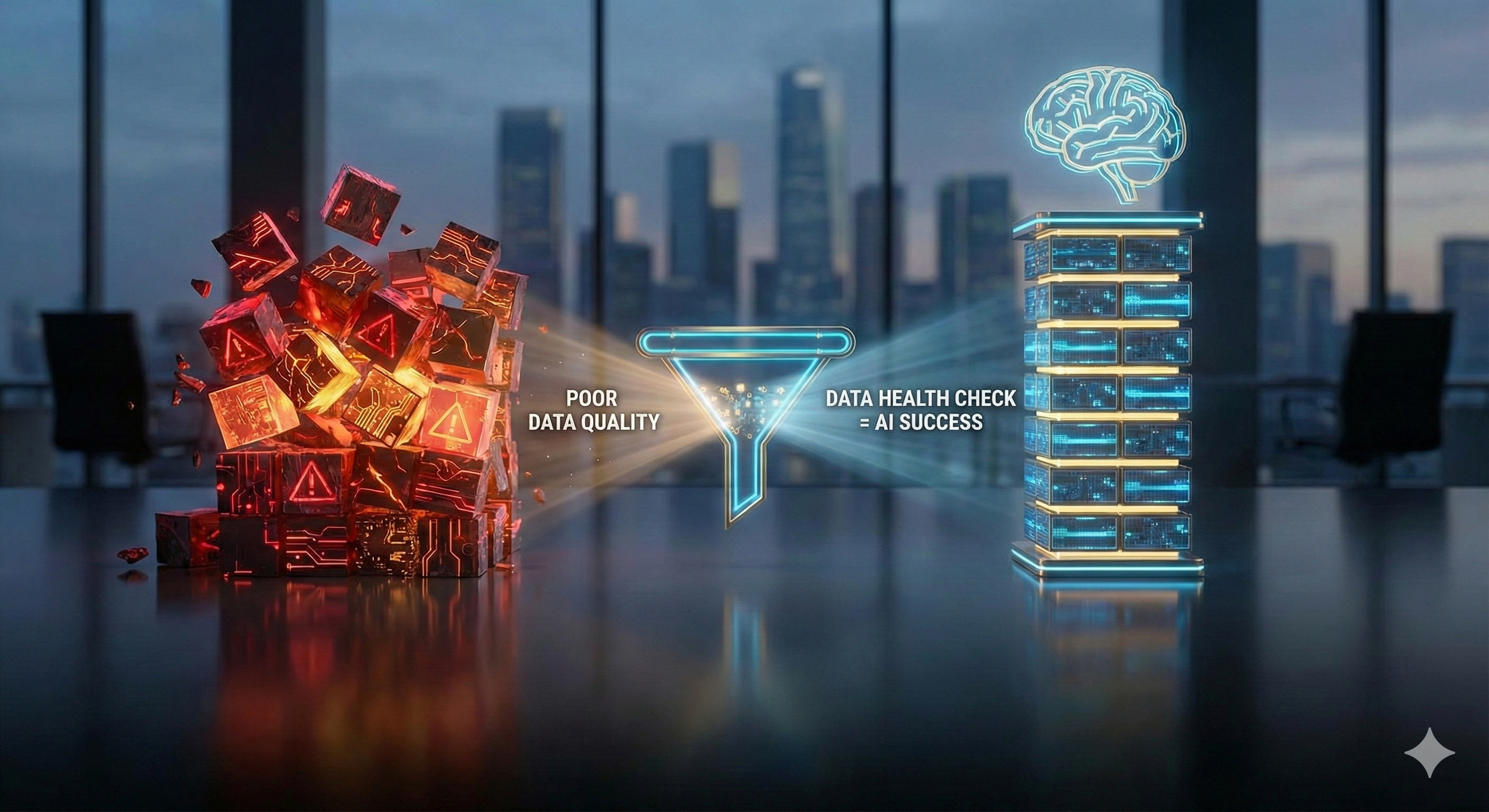

Take Action
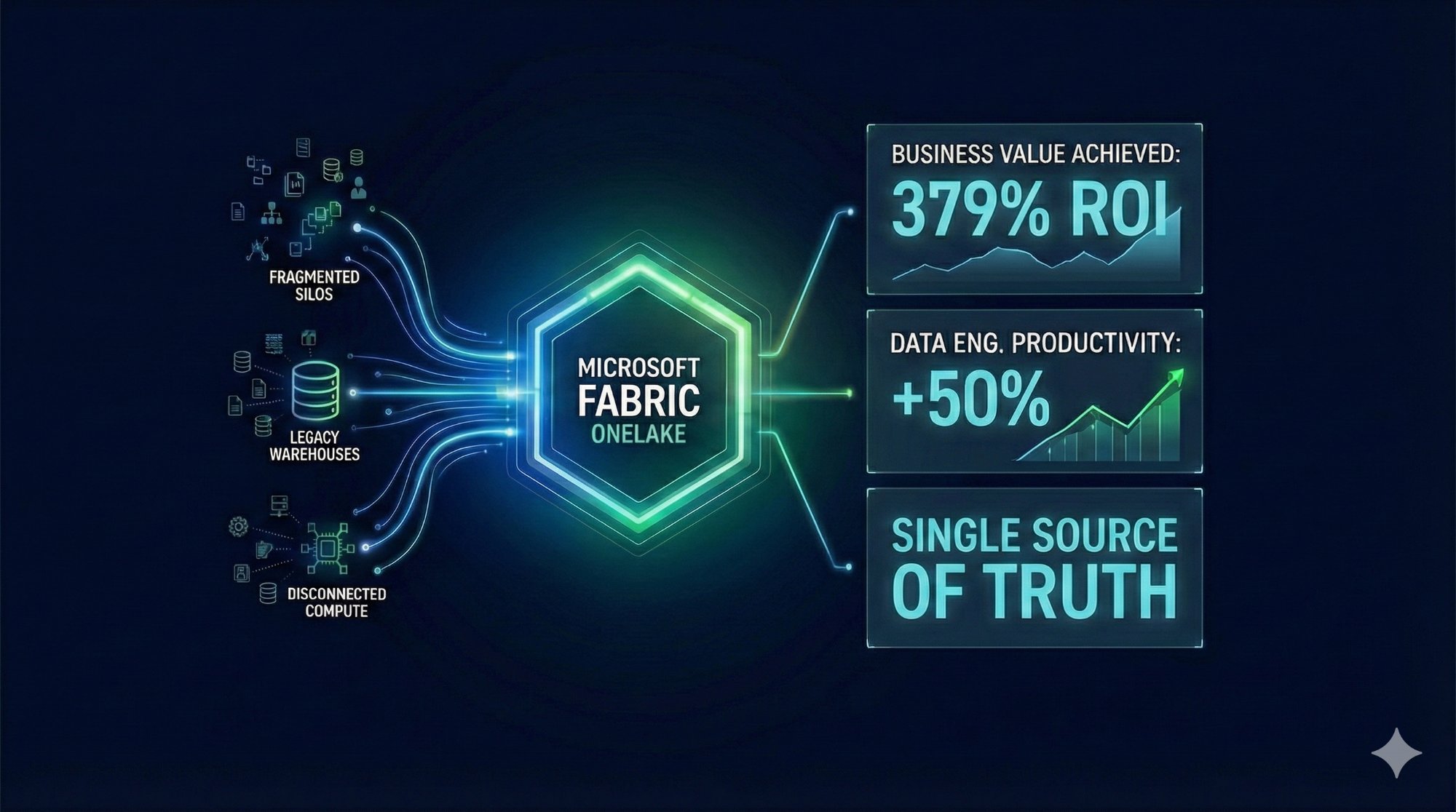
Microsoft Fabric: The Unified Data Platform
Understanding the Business Case for Data Estate Consolidation
A comprehensive guide to Microsoft Fabric's value proposition, architecture, and the business outcomes organisations are achieving—based on Forrester TEI research.
Key Takeaways
1
Organisations achieve 379% ROI over 3 years with Microsoft Fabric (Forrester TEI 2024)
2
Data Engineering productivity increases by 50% through unified architecture
3
Payback period of less than 6 months makes Fabric a low-risk investment
4
OneLake eliminates data silos without requiring data movement
Executive Summary
Microsoft Fabric represents the most significant evolution in Microsoft’s data platform strategy since the introduction of Azure. By unifying data engineering, data science, real-time analytics, and business intelligence into a single SaaS platform, Fabric addresses the fragmentation that has plagued enterprise data estates for decades.
This whitepaper examines the business case for Microsoft Fabric adoption, drawing on Forrester’s Total Economic Impact research and practical implementation considerations.
The Problem Fabric Solves
The Fragmented Data Estate
Most enterprise data estates have evolved organically over years or decades, resulting in:
- Multiple storage systems: Azure Blob Storage, ADLS Gen2, SQL Server, third-party data warehouses
- Disconnected compute: Different engines for ETL, analytics, data science, and reporting
- Duplicated data: The same information copied across systems, often with inconsistencies
- Integration overhead: Complex pipelines moving data between systems
The Cost of Fragmentation
According to Forrester’s research, this fragmentation imposes significant costs:
- Infrastructure redundancy: Paying for overlapping storage and compute
- Integration maintenance: Engineering time spent on data movement rather than value creation
- Governance complexity: Difficulty enforcing consistent security and compliance across systems
- Slow time-to-insight: Reports taking hours or days to refresh due to complex data pipelines
Microsoft Fabric: A Unified Approach
Explore the interactive platform diagram below to understand how Fabric’s experiences connect through OneLake—click any component to see details.
Microsoft Fabric platform architecture
Click any experience to explore how it integrates with OneLake.
OneLakeSingle copy of data
Forrester Total Economic Impact™ findings
379%ROI over 3 years
<6 monthsPayback period
50%Productivity increase
$779KInfrastructure savings
Source: Forrester TEI Study, June 2024
OneLake: The Foundation
OneLake is Fabric’s unified storage layer—a single data lake for your entire organisation. Key characteristics:
Single Copy of Data Rather than copying data between systems, OneLake provides a single storage location that all Fabric workloads access directly. This eliminates duplication and ensures consistency.
Shortcuts and Mirroring For data that must remain in existing systems (due to regulatory requirements or third-party ownership), shortcuts provide virtual access without physical movement. Mirroring keeps copies synchronised automatically.
Open Formats OneLake stores data in Delta Lake format—an open standard that prevents vendor lock-in and enables interoperability with non-Microsoft tools.
Direct Lake: The Performance Breakthrough
Traditional Power BI operates in two modes:
- Import: Fast queries, but data is duplicated and refresh is slow
- DirectQuery: No duplication, but queries can be slow for large datasets
Direct Lake is a third option unique to Fabric. Power BI reads directly from Delta tables in OneLake with import-like performance but no data duplication. Reports that previously took hours to refresh now update in seconds.
The Business Case
Forrester TEI Findings
Forrester’s Total Economic Impact study (June 2024) examined organisations that deployed Microsoft Fabric. Key findings for a composite organisation:
Return on Investment: 379% over 3 years
This ROI is driven by:
- Infrastructure consolidation savings
- Productivity improvements
- Accelerated time-to-value for analytics projects
Payback Period: Less than 6 months
The relatively low implementation cost combined with immediate infrastructure savings results in rapid payback.
Data Engineering Productivity: 50% increase
By eliminating low-value integration work, Data Engineers can focus on building analytics capabilities that drive business value.
Infrastructure Savings: $779,000
Decommissioning legacy SQL servers, Analysis Services instances, and redundant storage reduces ongoing costs.
Total Cost of Ownership Considerations
When evaluating Fabric’s TCO, consider:
Costs Reduced
- Azure storage (consolidated into OneLake)
- SQL Server/Analysis Services licensing
- Third-party ETL tool licensing
- Infrastructure management overhead
Costs Introduced
- Fabric capacity units (compute)
- Migration and implementation effort
- Training and change management
Costs Unchanged
- Power BI Pro/Premium licensing (often already in place)
- Data governance and security investment
For most organisations, the net effect is cost reduction plus significant capability improvement.
Implementation Considerations
The Migration Question
Fabric adoption doesn’t require “big bang” migration. Successful approaches typically follow:
Phase 1: Foundation
- Establish Fabric workspace and governance
- Configure OneLake shortcuts to existing data sources
- Enable Power BI Direct Lake for immediate value
Phase 2: Consolidation
- Migrate ETL pipelines from ADF to Fabric Data Factory
- Transition data warehouse workloads to Fabric
- Decommission redundant storage
Phase 3: Expansion
- Enable advanced scenarios (real-time, data science)
- Extend to additional business domains
- Optimise based on usage patterns
Common Pitfalls to Avoid
Underestimating Change Management Fabric changes how teams work. Data Engineers accustomed to separate tools need training on the unified experience.
Ignoring Governance OneLake makes data more accessible—which is powerful but requires robust governance to prevent misuse.
Over-Engineering Initial Implementation Start with high-value, low-complexity use cases. Prove value before tackling the most complex scenarios.
Neglecting Capacity Planning Fabric’s consumption-based pricing requires careful capacity planning to avoid cost surprises.
Who Should Consider Fabric?
Strong Fit
- Organisations already invested in Microsoft ecosystem (Azure, Power BI, M365)
- Companies with fragmented data estates seeking consolidation
- Teams spending excessive time on data integration vs. analysis
- Organisations planning significant analytics or AI investment
Less Clear Fit
- Companies with minimal Microsoft footprint
- Small data estates without fragmentation issues
- Organisations with heavy investment in competing platforms (Snowflake, Databricks)
- Teams without data engineering resources to manage the platform
Conclusion
Microsoft Fabric represents a genuine platform shift, not incremental improvement. For organisations in the Microsoft ecosystem struggling with data fragmentation, the business case is compelling: 379% ROI, sub-6-month payback, and 50% productivity improvement.
However, realising these benefits requires thoughtful implementation. Starting with a clear foundation, migrating incrementally, and investing in change management separates successful Fabric adoptions from those that underdeliver.
About Orion Data Analytics
Orion’s Fabric Launch Accelerator provides a structured approach to Microsoft Fabric adoption—establishing the foundation, migrating priority workloads, and ensuring your organisation captures the value Forrester’s research demonstrates is achievable.
Explore Fabric Launch Accelerator →
Explore Fabric Cost Rationaliser →
Sources: Forrester Total Economic Impact™ of Microsoft Fabric (June 2024), Microsoft documentation. Statistics represent Composite Organisation findings; individual results may vary.